












 |
|

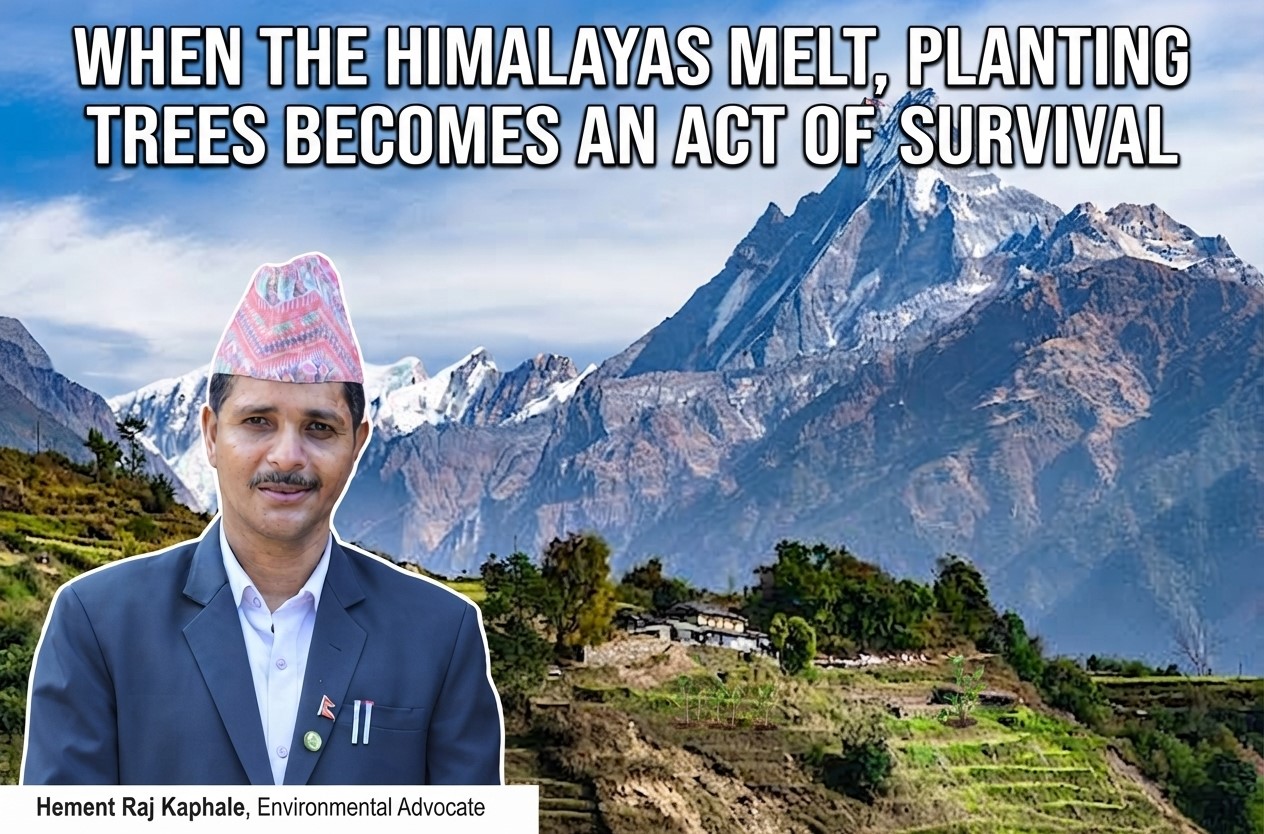
Hement Raj Kaphale / The Himalayas are not merely mountains standing silently above the clouds. They are the water towers of world the guardians of rivers, the source of countless springs, the foundation of agriculture an essential part of the ecological balance on which millions of people depend. For Nepal the Himalayas are also our identity our pride and our living heritage. But today that heritage is under unprecedented pressure. Rising temperatures are melting glaciers destabilising mountain landscapes, changing rainfall patterns increasing the risks of floods, landslides and other climate-related disasters. What once seemed like a distant environmental warning has now become a painful reality. The message from the mountains is clear the climate is changing humanity must change its relationship with nature.
Glacier melting is one of the most visible consequences of a warming planet. Glaciers are formed over thousands of years through the accumulation and compaction of snow. They move slowly through mountain valleys, storing enormous quantities of freshwater in frozen form. In the Himalayas this natural storage system regulates the flow of many rivers and supports ecosystems and human communities far beyond the mountains. When temperatures rise glaciers lose more ice than they gain from snowfall. At first, increased melting may appear to provide more water. But this is a dangerous illusion. In the long term shrinking glaciers mean less dependable water storage greater instability in high mountain areas and increasing threats from glacial lakes and sudden floods.
Nepal is particularly vulnerable because of its geography. We live between some of the world’s highest mountains and the densely populated plains of South Asia. Water originating in the Himalayas eventually travels through rivers, valleys, farms ,cities, crossing administrative and national boundaries. A climate disaster in a remote mountain settlement can therefore become a regional crisis. A landslide can block a river. A glacier can collapse. A glacial lake can overflow or burst. A debris flow can destroy roads, bridges, hydropower projects, homes and agricultural land within hours. The people living downstream may have little time to understand what is happening before the disaster reaches them.
The tragedy of recent floods and mountain disasters should therefore not be treated simply as isolated natural events. Every disaster has its immediate trigger, but the vulnerability behind it is often created over decades. Climate warming can intensify glacier retreat and destabilise mountain environments, while unplanned construction, deforestation, weak land-use planning and poorly designed infrastructure can increase the damage when extreme events occur. We must learn to distinguish between a natural hazard and a climate-vulnerable society. Mountains have always experienced floods, landslides and avalanches. What is changing is the scale, frequency, unpredictability human consequences of many hazards.
This is where the humble tree becomes extraordinarily important.
A tree may appear small compared with a glacier, a mountain or a river. But forests are among the most powerful natural systems available to humanity for protecting land and regulating the climate. Trees absorb carbon dioxide from the atmosphere and store carbon in their trunks, branches, roots and surrounding soils. Forests also influence local water cycles, reduce soil erosion, protect watersheds and provide habitats for biodiversity. When we plant protect forests, we are not simply decorating our landscape. We are strengthening one of nature’s own defence systems.
However we must be scientifically honest tree plantation alone cannot stop glacier melting. A few million trees planted in Nepal cannot compensate for the continued burning of coal, oil and gas across the world. The climate crisis requires rapid reductions in greenhouse-gas emissions, clean energy transitions, responsible consumption and strong international cooperation. But that does not make tree planting unimportant. It makes it one essential part of a much larger solution.
We should stop thinking of tree plantation as an annual ceremony in which dignitaries plant a few saplings, take photographs and leave. Tree plantation must become a long-term ecological responsibility. A sapling planted today is only the beginning. The real work is watering it, protecting it from animals and fire, maintaining it through drought, ensuring that the right species are planted in the right place and allowing the forest to mature. Planting a tree is an event growing a forest is a commitment. For Nepal this commitment must begin with our watersheds. Forests in the hills and mountains protect the soil that holds water. Their roots help stabilise slopes while forest litter and healthy soils increase infiltration and reduce rapid surface runoff.
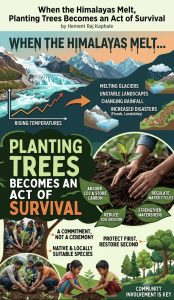
A healthy watershed can therefore contribute to more stable water availability and reduced erosion. Forests cannot prevent every landslide or flood, especially extreme events but degraded landscapes can be considerably more vulnerable to erosion and runoff. Protecting natural forests and restoring degraded land should therefore be treated as part of disaster-risk reduction. The relationship between forests water and climate is complex we must avoid simplistic claims.
Planting trees everywhere is not automatically good for every ecosystem. Some naturally open landscapes should remain open. Planting unsuitable species can consume excessive water, reduce biodiversity or damage local ecological processes. Monoculture plantations can never fully replace natural forests. Nepal therefore needs ecologically appropriate tree planting, using native and locally suitable species wherever possible combined with natural regeneration protection of existing forests. The most valuable forest is often the forest we do not destroy. This is why conservation must stand beside plantation. If an old forest is cut down and replaced with thousands of small saplings, we should not automatically declare the exercise a success. A mature forest contains complex layers of vegetation, microorganisms, soil organisms, wildlife stored carbon ecological relationships that take decades or centuries to develop. Young plantations are important for restoration but they cannot instantly replace mature ecosystems. Our environmental policy should therefore follow a simple principle protect first, restore second, plant where appropriate.
The Himalayas also need a different kind of attention. We cannot plant trees at the top of every glacier or above the natural tree line. High-altitude ecosystems have their own ecological limits. The solution is not to cover the Himalayas artificially with trees. It is to protect forests and watersheds at suitable elevations, restore degraded slopes, conserve alpine ecosystems and wetlands monitor glaciers and glacial lakes reduce the greenhousegas emissions driving global warming. Climate change is not only an environmental issue. It is an issue of food, water, health, migration, education, economy national security. When a glacier changes the consequences may eventually reach a farmer cultivating rice in the plains. When a landslide destroys a road, the price of transportation rises. When a flood destroys a school, children lose their learning environment. When agricultural land is buried under sediment, families lose income. When hydropower infrastructure is damaged, electricity generation suffers. Climate change therefore enters our lives through many doors. For Nepal’s farmers, changing rainfall can be particularly devastating. Agriculture depends on predictable seasons. Too much rain in a short period can wash away soil and crops, while prolonged dry periods can reduce yields. Springs in mountain communities may decline. Traditional water sources can become unreliable. Warmer temperatures can change the distribution of pests and diseases. The climate crisis is therefore also a food-security crisis.
Our forests can help communities adapt adaptation must be broader than plantation. We need climate-resilient agriculture, rainwater harvesting, watershed restoration, early-warning systems, climate-resilient infrastructure and disaster preparedness. Local governments should map high-risk areas ensure that settlements and infrastructure are not unnecessarily exposed to hazards. Hydropower, roads, bridges and tourism infrastructure in mountain regions must be designed with changing climate risks in mind.
Nepal also needs better glacier monitoring. We cannot manage what we do not understand. Satellite observations, field measurements, automatic weather stations, river monitoring and community-based early-warning systems should be strengthened. Scientists need access to reliable long-term data. Local communities should not be treated merely as victims they should be partners in monitoring and preparedness. Mountain people possess generations of knowledge about weather, rivers, slopes and seasonal changes. Modern science and indigenous knowledge can complement each other.
The international community also has a moral responsibility toward countries such as Nepal. Nepal contributes very little to historical global greenhouse-gas emissions compared with major industrial economies, yet our people face severe consequences from a warming planet. This is the heart of the climate-justice argument. Those who have contributed most to the accumulation of greenhouse gases must accept greater responsibility for financing adaptation, loss and damage, technology transfer and resilient development in vulnerable countries.
Our mountains should not become laboratories of climate catastrophe.
The world cannot celebrate the Himalayas in tourism advertisements while ignoring the climate emergency threatening them. People travel to Nepal to see Everest, glaciers, beautiful forests and mountain landscapes. But the tourism industry itself depends on a stable environment. If glaciers retreat, ecosystems change and disasters become more frequent, tourism will also face increasing risks. Protecting the Himalayas is therefore not only a responsibility toward nature; it is an investment in Nepal’s future economy.
There is another reason why tree planting matters: it creates environmental consciousness. When a child plants a sapling, something changes beyond the soil. The child begins to understand that nature requires patience. A tree does not grow because we command it to grow. It grows because we care for it. It teaches a lesson that modern society urgently needs not everything valuable can be produced instantly. Schools should therefore become centres of ecological education. Every school could maintain a small native-tree garden, biodiversity corner or watershed-awareness programme. Students could learn to identify local species, measure tree growth, collect seeds and understand the connection between forests, rivers and climate. Environmental education should move outside the classroom and into the landscape.
Universities, municipalities, community forests, private organisations and civil society should work together to create long-term restoration programmes. We need fewer ceremonial plantations and more survival monitoring. Every plantation programme should have a simple question attached to it: How many of these trees will still be alive after five years?
That question would transform environmental work.
If one million saplings are planted but only one hundred thousand survive, the headline should not say “one million trees planted.” It should ask why nine hundred thousand failed. Did we choose the wrong species? Was there no water? Were the seedlings damaged by grazing? Was maintenance ignored? Did we plant during the wrong season? Did we fail to involve local communities? Environmental programmes should be measured by survival, ecological value and long-term impactnot by the number of photographs taken on plantation day. Nepal has a remarkable opportunity because our community forestry experience has already demonstrated that local people can play a central role in managing forests. The future should build upon this experience while introducing stronger scientific monitoring, climate adaptation and biodiversity conservation. Local communities must receive incentives and benefits from protecting forests. When people see forests as sources of water, livelihood, biodiversity, fuel, fodder, fruits and climate protection, conservation becomes a shared interest rather than an imposed rule.
Tree planting can also be connected to the restoration of river corridors. Rivers need living landscapes around them. Vegetation along riverbanks can help stabilise soil and provide habitat. Urban areas can develop green corridors, parks and roadside plantations where appropriate. But again, planning matters. Trees should not be planted blindly where they interfere with river flow, infrastructure or safety. Cities need trees too. As Nepal urbanises concrete is replacing soil and vegetation. Roads, buildings and paved surfaces absorb and retain heat. Trees provide shade and can help reduce urban heat stress. Green spaces also improve the quality of urban life. A city with trees is not simply more beautiful it can be healthier and more resilient.
Nepalgunj, Kathmandu, Pokhara, Butwal, Nepalgunj and other growing cities should think of urban trees as essential infrastructure. We routinely budget for roads, drains, electricity and buildings. Why should trees be treated as optional decoration? Urban forestry should be included in municipal planning, with species selection based on local climate, available space, root behaviour, water needs and biodiversity value. But our environmental responsibility extends beyond planting. We must reduce waste, conserve energy, use public transportation where possible, protect wetlands reduce unnecessary concrete, harvest rainwater and consume more responsibly. A tree cannot absolve society from pollution. We need a culture in which environmental responsibility becomes part of everyday life. The climate crisis also demands political courage. Governments often prefer projects that can be completed within an election cycle. A forest does not work according to election calendars. A tree planted today may provide its greatest ecological value decades later. This means environmental policy requires intergenerational thinking. Political leaders must be willing to invest in benefits that may be enjoyed primarily by future citizens.
The same principle applies to glaciers. A glacier does not belong only to the generation living today. It is part of a natural inheritance passed from the past to the future. If we allow it to disappear through irresponsible development and unchecked emissions, future generations will inherit the consequences of decisions they did not make. This is why climate education must become a national priority. Children should know that carbon dioxide is not simply a word from a science textbook. It is connected to the fuel used in vehicles, the electricity generated by power plants, the products we consume and the forests we protect or destroy. They should understand that a glacier in the Himalayas and a factory thousands of kilometres away can be connected through the atmosphere. The atmosphere does not respect national borders. Carbon emitted in one country affects the climate of every country. That is why climate change cannot be solved by Nepal alone. Nepal must do its part, but the world’s major emitters must move much faster. International climate agreements must translate into meaningful action. Climate finance must reach vulnerable communities rather than becoming another complicated bureaucratic promise.
The United Nations must stand at the centre of the global response to the climate crisis, particularly for developing countries like Nepal that are facing the consequences of a problem they did little to create. When our glaciers melt, rivers rise, mountains collapse and communities suffer from floods and landslides, Nepal is not only experiencing a national disaster it is witnessing the consequences of a changing global climate. The United Nations and developed nations must therefore move beyond promises and provide meaningful climate finance, technology, scientific cooperation, early warning systems and support for adaptation loss and damage, forest conservation and watershed restoration. Nepal also has a responsibility to protect its forests, plant and nurture trees, restore degraded landscapes and build climate-resilient communities, but our efforts alone cannot solve a crisis created by global emissions. If the world truly believes in climate justice, the nations that have contributed most to global warming must help protect the countries and communities suffering most from it. Saving Nepal’s Himalayas is not only about saving Nepal; it is about protecting the rivers, forests, biodiversity and millions of lives that depend on the Himalayan ecosystem. The United Nations must make the voice of the mountains heard in every climate negotiation, because when the Himalayas suffer, the world cannot remain safe.
Adaptation funds should support practical projects early-warning systems, resilient roads, watershed restoration, climate-resilient agriculture and community preparedness. At the same time, Nepal should not use its vulnerability as an excuse for inaction. We have enormous opportunities in renewable energy, electric mobility, sustainable tourism, forest restoration and climate-smart agriculture. A cleaner economy can also be a stronger economy. Our hydropower potential, if developed responsibly, can help reduce dependence on fossil fuels. Electric vehicles can reduce urban air pollution. Sustainable forests can provide livelihoods while storing carbon. Agroforestry can combine food production with ecological restoration. Moringa and other climate-resilient crops can contribute to nutrition livelihood diversification in appropriate regions. Innovation must become part of our environmental movement. But we must remember one fundamental truth: nature is not a machine that can be repaired after destruction simply by spending money.
Some losses are irreversible.
Once a species becomes extinct, it cannot be brought back through plantation. Once a glacier disappears, rebuilding it naturally may take centuries. Once an ancient forest is destroyed, planting seedlings cannot recreate its ecological complexity overnight. Once a traditional community is displaced by repeated disasters, its cultural heritage may also disappear.
Therefore, prevention is more powerful than repair.
We need to change the language of development. Development should not mean cutting mountains without understanding their geology, building beside rivers without respecting floodplains or destroying forests and promising to plant replacements later. True development means improving people’s lives while keeping the natural systems that sustain those lives intact.
The Himalayas are sending us warnings through shrinking ice, unstable slopes, changing springs and increasingly unpredictable hazards. We should listen before the warnings become irreversible losses.
Every tree we plant should therefore carry a message.
It should say that we recognise our responsibility.
It should say that we understand the connection between forests and climate.
It should say that we refuse to leave a damaged planet to our children.
But that message becomes meaningful only when the tree survives.
I have always believed that loving trees is not a slogan it is a way of life. A person who plants a tree plants something beyond his or her own lifetime. The tree becomes a gift to people we may never meet. It gives shade to a stranger, oxygen to a child, habitat to a bird, roots to the soil and perhaps water to a village. It asks for little in return except protection.
This is the spirit we need today.
Let us plant treesbut let us also protect forests.
Let us restore degraded hills but let us also reduce emissions.
Let us monitor glaciers but let us also act on the causes of their melting.
Let us build roads and hydropowerbut let us build them with climate and ecological wisdom.
Let us prepare for disasters but let us also reduce the risks that we can control.
Let us demand climate justice from the worldbut let us also accept our own responsibilities at home.
The fight against climate change will not be won by one person, one government, one organisation or one country. It will be won through millions of decisions made by citizens, communities, scientists, businesses and governments.
A farmer protecting a watershed is part of the climate solution.
A child planting and caring for a native tree is part of the climate solution.
A municipality preserving its river corridor is part of the climate solution.
A scientist monitoring a glacier is part of the climate solution.
A government investing in early warning systems is part of the climate solution.
A country reducing fossil fuel dependence is part of the climate solution.
And a global community that accepts responsibility for climate injustice is part of the solution.
The question before us is no longer whether climate change is real. The question is whether we are prepared to act at the scale required.
The Himalayas cannot speak in human language, but their melting ice is a message. Rivers carry another message. Landslides carry another. Dying springs carry another. Forests burned or cleared by human hands carry another.
We must listen.
Nepal stands at the frontline of a changing climate. Our mountains are warming our glaciers are retreating, our ecosystems are under pressure and our communities are increasingly exposed to extreme events. Yet Nepal is not powerless. We possess forests, rivers, renewable-energy potential, community institutions, scientific knowledge and, most importantly, people who care deeply about the land.
We must turn that potential into action.
Plant a tree. Protect a forest. Restore a watershed. Monitor a glacier. Reduce emissions. Prepare communities. Demand climate justice.
And above all, let us understand that these are not separate battles. They are parts of one struggle the struggle to protect the living systems that make human life possible.
The future of the Himalayas is connected to the future of Nepal. The future of Nepal is connected to the future of South Asia. And the future of South Asia is connected to the future of the planet.
If we save forests, we strengthen watersheds.
If we strengthen watersheds, we strengthen communities.
If we reduce emissions, we slow global warming.
If we slow warming, we give glaciers a better chance of survival.
And if we protect the Himalayas, we protect not only a mountain range, but a life-support system for generations yet unborn.
A sapling in the soil may look small today. A glacier on the mountain may look enormous. But both are part of the same climate story. One is disappearing because the planet is warming; the other can help us heal the land and store carbon. Let us not wait until the mountains are bare and the rivers are angry to understand the value of a tree.
The time to plant is now.
The time to protect is now.
The time to act for the Himalayas is now.


