








 |
|

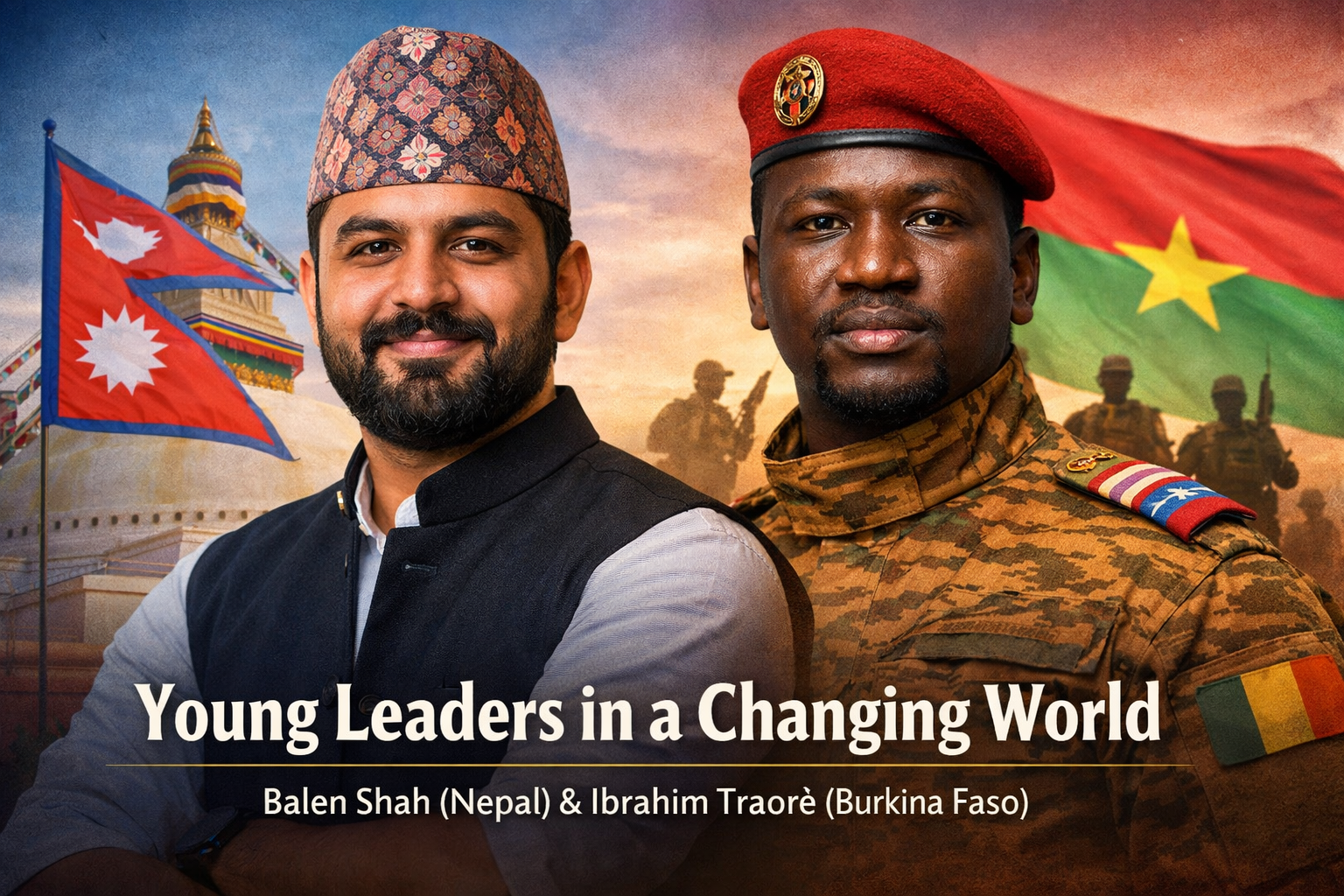
Hement Raj Kaphale / In today’s rapidly transforming world leadership is no longer confined to age old traditions or rigid political systems. A new wave of young leaders is rising in the world challenging the status inspiring hope and reshaping societies with bold ideas and fearless actions. Among such figures Balendra shah from Nepal and Ibrahim Traore from Burkina Faso stand out as powerful examples of youth driven leadership. Though their paths are different one rooted in democracy and the other in military transition their stories echo a shared message the youth are no longer waiting for the future they are creating it.
Prime minister Balendra Shah was born on 27 April 1990 in Kathmandu Nepal. He comes from a Madhesi origin family his father Ram Narayan Shah was an Ayurvedic doctor and his mother is Dhruvadevi Shah. His family originally belonged to Mahottari district but later settled in Kathmandu due to his father’s work. He is the youngest son in his family and grew up in a modest but supportive environment that encouraged education and creativity. Balen later married Sabina Kafle he has one daughter also .
To understand both leaders significance one must first reflect on the changing nature of leadership itself. Gone are the days when leadership was defined solely by age hierarchy or inherited power. Today leadership is measured by vision courage, action and the ability to connect with people. In this sense Nepal prime minister Balen Shah emerges as a symbol of democratic awakening among Nepali youth. His journey from a civil engineer and rapper to the mayor of Kathmandu and now prime minister of country is not just a personal success story it is a collective expression of public frustration and hope. People especially the younger generation saw in him a reflection of their own dreams dreams of a clean organized and corruption free city.
Balen’s leadership style is marked by direct action and accountability. He does not merely speak he acts. His decisions often create waves of debate. Yet it is precisely this willingness to act that sets him apart. In a society where bureaucracy and delay have long hindered progress his approach feels refreshing and necessary. He represents a shift from passive governance to active leadership from promises to performance.
On the other side of the world Ibrahim Traore’s story unfolds in a vastly different context. Burkina Faso a nation grappling with political instability and security challenges, witnessed a dramatic shift in leadership when Traore took power in 2022. Unlike Balen his rise was not through ballots but through a military coup. This difference is significant and cannot be ignored. Democracy and military rule are fundamentally different systems each carrying their own implications. However beyond this contrast lies an interesting similarity both leaders gained prominence because people were seeking change.
Traore’s leadership is shaped by urgency and crisis. In a country facing threats from armed groups and internal instability, his focus is on restoring order, strengthening national sovereignty and ensuring security. His speeches often emphasize self reliance patriotism and resistance against external influence. For many in Burkina Faso he represents a strong figure willing to take decisive action in difficult times. While the method of his rise may be debated his popularity among certain sections of society reflects a deep desire for stability and direction.
When we bring these two leaders into a single frame the contrast becomes a powerful lesson. Balen Shah represents the strength of democratic systems where people choose their leaders and hold them accountable. Ibrahim Traore’s represents a response to crisis where swift centralized power is seen as a solution. One works within institutions to reform them the other reshapes the system itself in response to immediate threats. Yet both highlight the same truth leadership is ultimately about responding to the needs of the people.
True leadership is not about power it is about responsibility. It is about planting seeds of change nurturing them with dedication and ensuring that future generations inherit a better world. Just as a tree grows silently but steadily real change often begins with small consistent actions. The daily efforts to improve nations can be seen as seeds planted in challenging soil requiring patience courage and commitment.
Another important aspect of modern leadership is the role of youth. Both Balen and Traor’s are relatively young and this itself sends a strong message. Youth is often associated with energy innovation and risk-taking. However it also comes with challenges such as inexperience and criticism. What defines successful young leaders is their ability to learn, adapt and remain grounded. Their connection with people and ability to inspire collective action show how youth can shape the direction of a nation.
Moreover leadership today is closely tied to communication. In the age of social media and instant information leaders are constantly visible and accountable. Effective communication builds trust encourages participation and strengthens the relationship between leaders and citizens. Whether through public addresses or modern digital platforms communication has become a key tool of influence and governance.
However it is also important to critically examine the differences. Democracy provides space for dissent debate and correction. It allows citizens to question their leaders and demand accountability. Military leadership while efficient in decision making often limits these freedoms. Therefore while appreciating the strengths of both leaders one must also recognize the importance of democratic values such as freedom equality and participation. These values ensure that leadership remains a service not a form of control.
In a broader sense the stories of Balen Shah and Ibrahim Traore’s reflect the diversity of global leadership. Each country has its own history challenges and aspirations. There is no single model that fits all. What matters is the outcome whether leadership improves the lives of people, promotes justice and builds a sustainable future. In this regard both leaders are under constant observation and their true legacy will be determined by the long term impact of their actions.
Leadership must also be understood through the lens of sustainability and harmony. Development should not come at the cost of nature or social balance. A truly great leader is one who understands the interconnectedness of people environment and progress. In places rich with natural and cultural heritage leaders carry the responsibility to ensure that growth respects ecological balance while improving quality of life.
As we reflect on these leaders we are also invited to reflect on ourselves. Leadership is not limited to those in power it exists in everyday actions. A teacher shaping young minds a farmer nurturing crops, a student striving for knowledge all are leaders in their own way. Their efforts though small contribute to the larger progress of society.
Balen Shah and Ibrahim Traore represent two different paths in the journey of leadership yet both highlight the power of youth courage, change and vision. One emerges from the voice of the people the other from the urgency of crisis. One builds within a system the other transforms it. But both remind us that the future belongs to those who dare to lead to act and to serve. Leadership is not just a position it is a purpose a commitment to nurture protect and uplift the world around us just like planting a tree whose shade may benefit generations to come. They both are the hope of this era and example for world leader .
(Writer is social activist and principal of British secondary school Nepalgunj )


